Reading time: 8 minutes
Text and pictures: Voxelmatters
- 426 unique metal AM companies surveyed and studied.
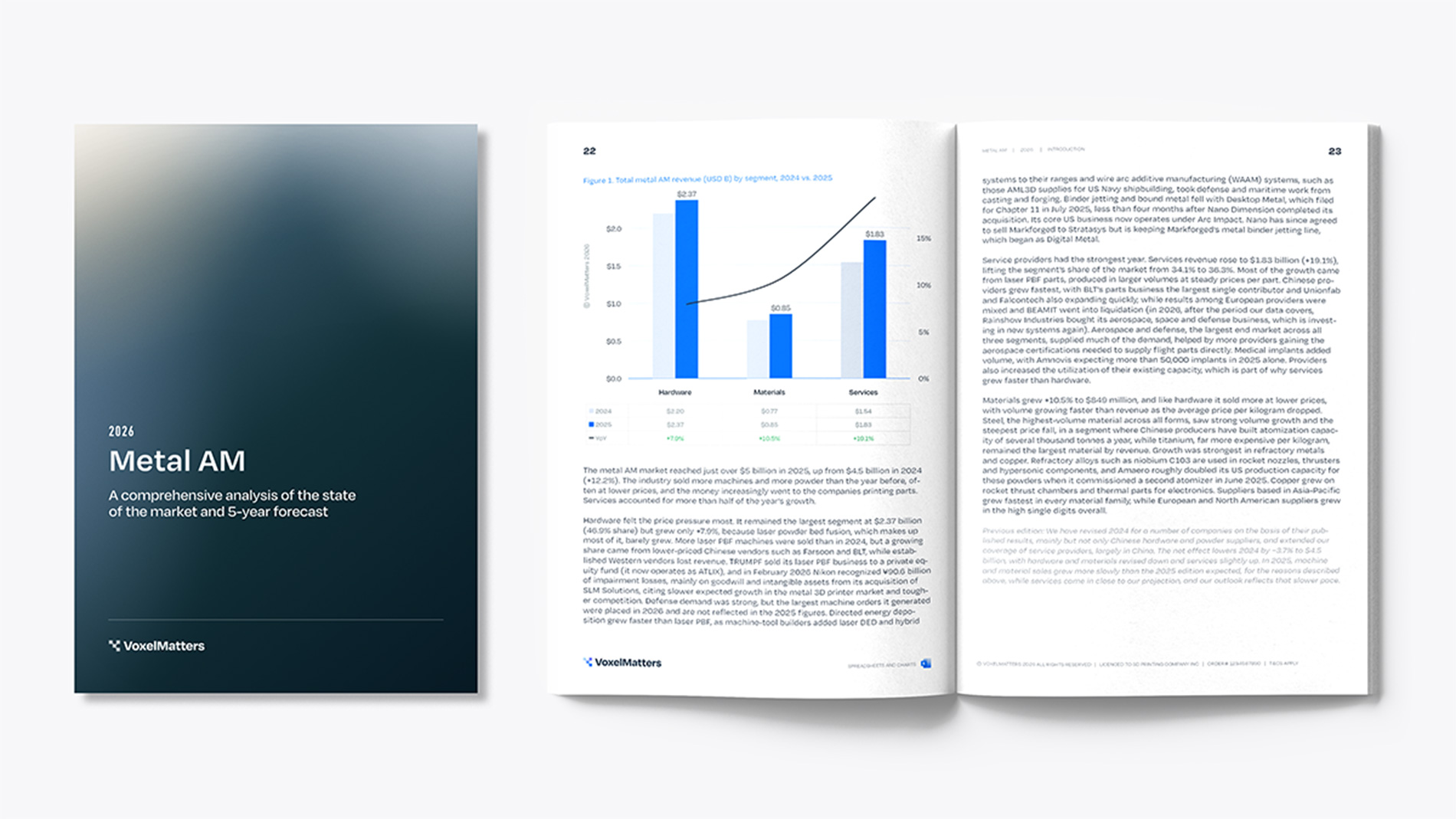
- Metal AM hardware, materials and services generated just over $5 billion in 2025.
- Market forecast to reach about $14.7 billion by 2030 at a +23.9% CAGR.
This new market study from VoxelMatters provides one of the most in-depth analyses and forecasts of the metal additive manufacturing market (revenue and units), including hardware, materials and services, by end-user segment and geography.
The report includes the full dataset for hardware, materials and services. These can also be ordered separately here.
About the report
For many of the companies that built metal additive manufacturing, 2025 was a harder year than the market’s growth suggests. Revenue from laser powder bed fusion (L-PBF), the technology most of them were built on, barely grew even as more machines were sold, because a growing share of those machines came from lower-priced Chinese companies. In hardware, growth came instead from technologies that build large parts, as defense, energy and maritime buyers turned to directed energy deposition (DED), including wire arc additive manufacturing (WAAM), and to cold spray to replace castings and forgings that can take many months to source.
Several of the best-known names in the industry went through insolvency, restructuring or a change of owner during the year. Even so, more machines, more feedstock and more printed parts were sold than in 2024, and service providers did more than any other group to drive growth. Metal AM is growing as a production industry, with final parts now the fastest-growing type of part that service providers make. This edition of our market study follows that shift across hardware, materials and services, with the global market broken out by technology, sub-technology, end-user segment and geography.
The total metal AM market grew +12.2% in 2025 to just over $5 billion. Hardware remained the largest segment, but services grew fastest, with service providers adding more revenue than hardware and materials companies combined and taking a larger share of the market.
In hardware, powder bed fusion (PBF) still accounted for most revenue, but its revenue grew only slightly as average L-PBF prices fell, and during the year Chinese companies’ L-PBF revenue was ahead of that of German companies. DED supplied half of the hardware revenue added, with WAAM growing faster than DED as a whole and cold spray faster still on defense and repair demand. Binder jetting was the one area to shrink, held back by restructuring among the companies that sell it rather than necessarily by weaker demand for the technology.
Desktop Metal filed for Chapter 11 protection in July 2025, and Arc Impact bought its core binder jetting and materials business to relaunch it around US production. TRUMPF sold its PBF business, which now operates as ATLIX. Paste extrusion more than doubled its revenue and attracted investment, as Angstrom Group acquired Mantle and Stratasys took a minority stake in Tritone. Orders placed in 2026, which will show in next year’s edition, suggest defense demand has further to run; Beehive Industries alone ordered 30 EOS M4 ONYX systems to build engines for uncrewed defense aircraft.
On the materials side, volume grew faster than revenue because much of the added volume was wire for WAAM and wire-fed laser DED, which costs far less per kilogram than powder. Powder still made up the large majority of materials revenue, with prices holding. Titanium and steel remained the largest powders but gained less than the rest, while refractory metals and copper alloys grew fastest on demand from space propulsion, defense and naval programs, with new supply agreements signed for niobium alloy C-103 and copper-nickel.
Most of the service providers’ growth came from L-PBF parts, and part of it from making fuller use of the machines they already had, since their spending on new machines grew only modestly. Final parts grew faster than prototypes and tooling as more providers gained the qualifications needed to supply flight parts directly, while DED and cold spray services grew fastest of all, from a much smaller base.
Companies based in APAC accounted for more than half of the market’s growth and gained share. EMEA companies remained the largest group, but APAC hardware companies all but closed the gap with them, and APAC service providers grew more than twice as fast as those in EMEA and North America. By end market, aerospace and defense was the largest across all three segments.
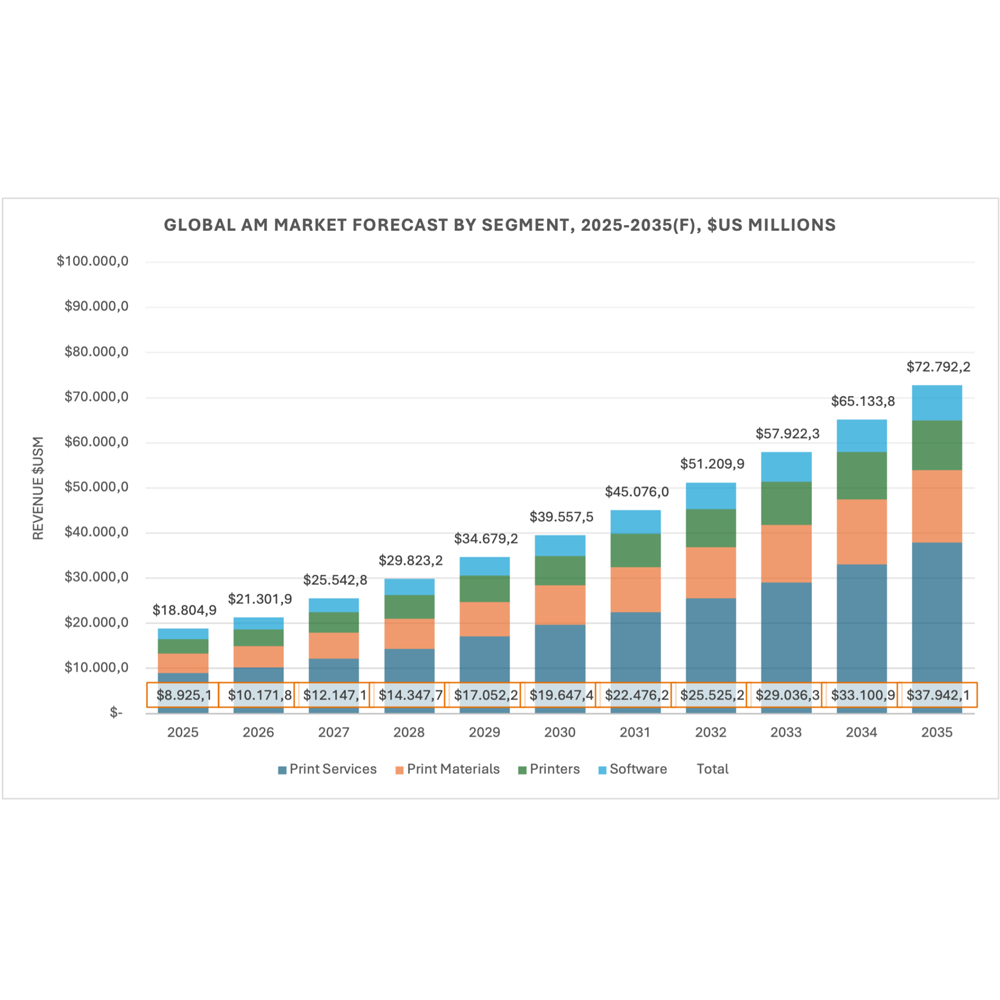
Based on the trends of 2025 and earlier years, and on the orders already placed in 2026, we forecast total market revenue to reach about $14.7 billion by 2030, a +23.9% CAGR. We expect materials to grow fastest of the three segments as larger fleets run at higher utilization and print larger parts, DED to lead growth among the main hardware technologies, and aerospace and defense to gain share on defense demand. How quickly the established hardware companies return to stronger growth will depend on how fast service providers and end users work through the capacity they already have, and on how far Chinese companies push prices down.
Drawing on the VoxelMatters Directory, one of the largest AM company databases worldwide with more than 8,000 listings, our research team identified 130 hardware manufacturers, 99 materials suppliers and 270 service providers. Some companies operate in more than one segment, so these 499 segment-level entries cover 426 individual companies, and our coverage widened in every segment compared with the previous edition. The underlying dataset runs to about 118,000 data points, and the report includes 70 charts and figures.
Established and emerging companies covered in the report include
3D Systems, Additive Industries, ADDMAN, AddUp, AML3D, ATI, ATLIX, AVIMETAL, Bright Laser Technologies (BLT), Caracol, Carpenter Additive, Colibrium Additive, Continuum Powders, Cumberland Additive, DMG MORI, EOS, Eplus3D, Farsoon, FIT AG, FOMAS Group/Mimete, GF Machining Solutions, HBD, Höganäs, HP, JAMPT (Sojitz), JEOL, Legor, Linde AMT, Materials Solutions (Siemens Energy), Nikon SLM Solutions, Oerlikon, Pankl, Protolabs, Quickparts, Renishaw, Sandvik*, Sciaky, Sintavia, SPEE3D, Toolcraft, TRUMPF, UnionTech/Unionfab, Velo3D, voestalpine, XJet, among many others.
*Sandvik sold its Osprey metal powder business to Mimir in October 2026.
The report supports existing suppliers in their market analysis and planning, and it is built to help companies entering metal AM decide where to compete. OEMs weighing metal AM for part production will come away with a clear picture of the technologies, materials and services available today, along with their benefits and trade-offs. Investors can use it to judge which technologies and companies are best placed to grow.
To learn more about the scope and methodology of this study, please contact us.