Reading time: 1 minutes
Text and pictures: 3D Adept
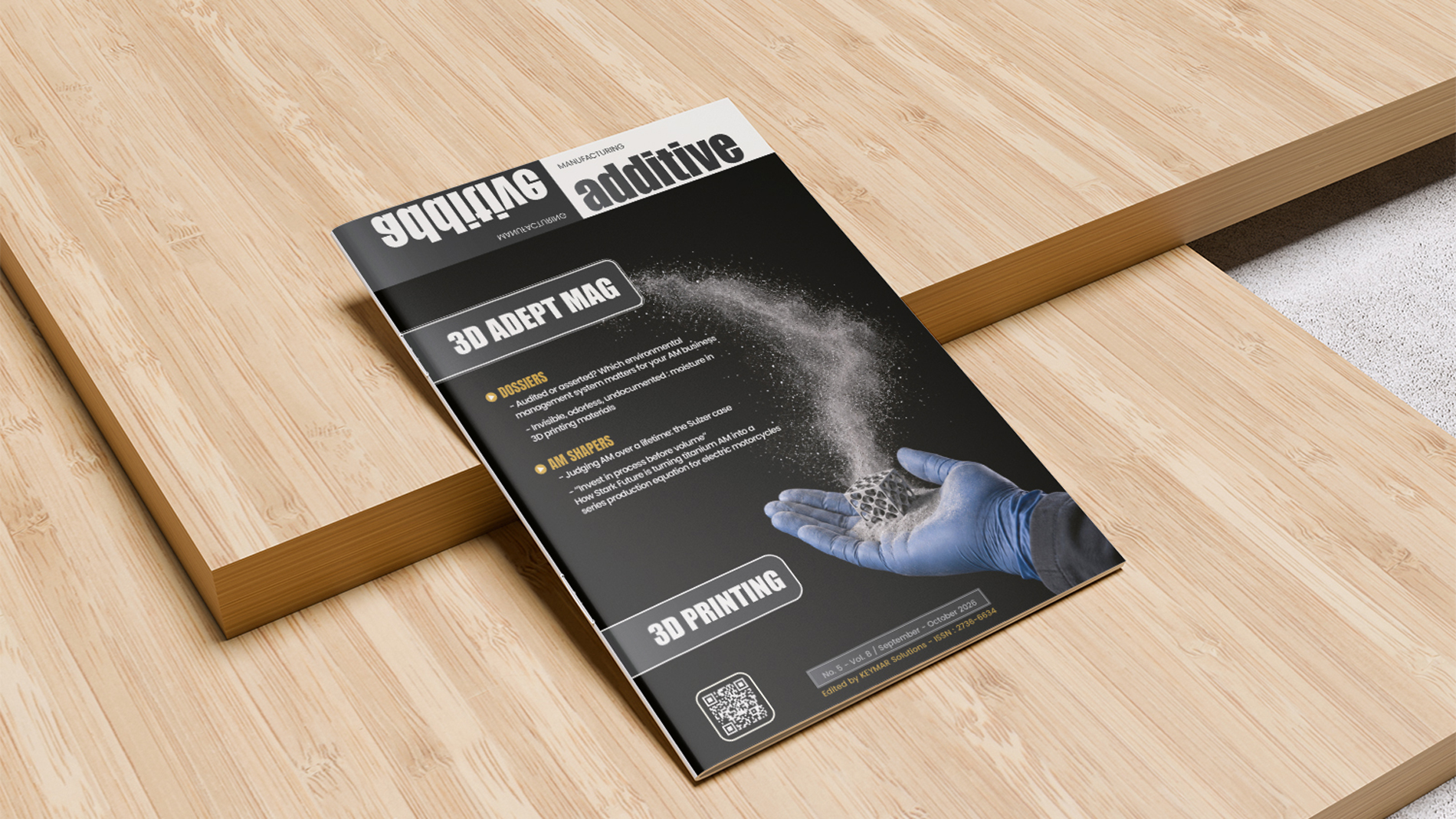
Pick up your print copy at Formnext, Hall 12.0 P02
Many in the aerospace industry believed that landing an orbital-class booster upright was impossible and wouldn’t make economic sense.
After several major failures, SpaceX landed its first Falcon 9 booster in December 2015. The company proved both the physics and the business case and forced legacy aerospace giants to rewrite their long-term strategies.
This is one example among thousands where companies had to prove a concept that everyone else thought was impossible, foolish, or bound to fail.
Sometimes, I am tempted to believe that sustainability in our industry has never really been put to such a test. Because AM does not deliver the production volumes of conventional manufacturing, the pressure to prove its environmental case is not the same.
If you read these lines and think I am just another person who will talk about a topic that is not a priority for your business right now, let me share another angle: every 3D printed part is produced with the hope that it will perform as intended, and that choosing additive manufacturing was truly the right choice.
With that in mind, we asked ourselves: “what else does AM need to prove?”
Our opening dossier reveals that the decision to pursue environmental certification is increasingly driven by customers’ supplier questionnaires. Our investigation into recycled metal powders highlights different models of traceability, qualification and ISO-based environmental data while our in-depth feature on moisture examines the importance of knowing what happens to a powder between its production and its use.
The same attention to the complete process runs through our production features from Materialise and Solukon to Incus.
While these insights show how much industrial performance depends on the connections between individual steps, the stories of Stark Future and Sulzer confirm there is still room for optimism. In the end, if the operational case is a success, there is a great chance that the sustainability claim naturally follows.